

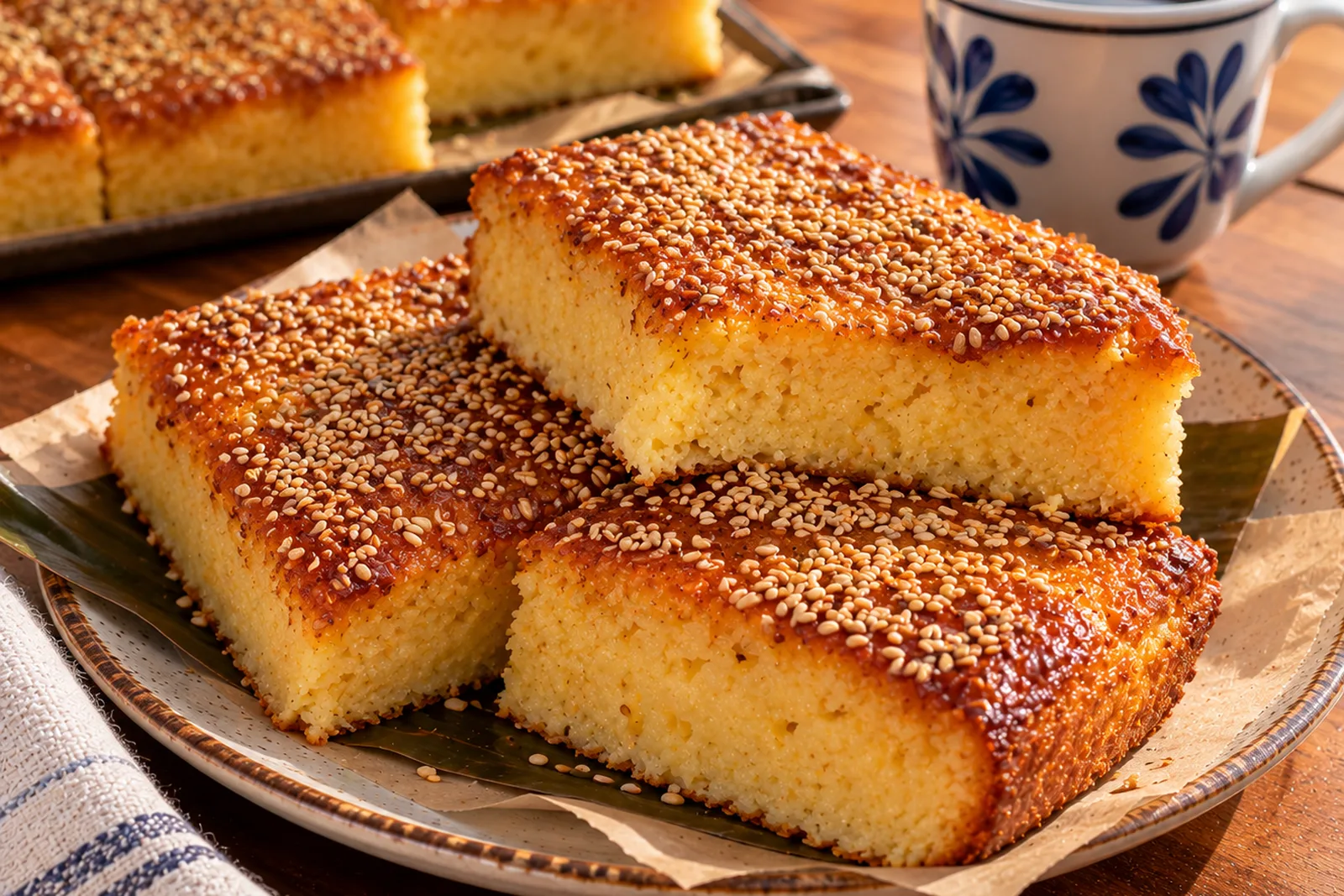

In El Salvador, a quesadilla (keh-sah-DEE-yah) isn’t a folded tortilla at all. It’s a sweet, dense cheese bread baked in a sheet pan, made with rice flour, melted butter, sugar, eggs, a salty dry cheese and a tangy cream, with sesame seeds toasted on top. Think of a pound cake crossed with cornbread, salty and sweet at once, cut into squares and eaten with coffee. This version fills a 9x13 pan, needs only a bowl and a whisk, and every ingredient has a US or UK supermarket stand-in.
What a Salvadoran quesadilla is, and how it turns out
How do you make a Salvadoran quesadilla? Whisk 1 cup (225 g) melted butter with 1½ cups (300 g) sugar and 4 eggs, then stir in 1½ cups (150 g) grated queso duro or Parmesan, ½ cup sour cream or crema and ½ cup milk. Fold in 1½ cups (240 g) rice flour with 1½ tsp baking powder, pour into a 9x13 in pan, cover with sesame seeds and bake at 350°F (175°C) for 35 to 45 minutes, until a toothpick comes out clean. 60 minutes for 16 servings.
It’s a Salvadoran pan dulce, eaten at breakfast or in the afternoon with a cup of coffee. The traditional version uses rice flour; all-purpose flour is also widely used, and both work here. If you came looking for the tortilla kind, those are Mexican quesadillas with Oaxaca cheese. The savory Salvadoran classic with cheese inside is a different dish too: Salvadoran pupusas, griddled corn cakes with a sealed filling.
Texture. Close-crumbed and moist, slightly sandy from the rice flour, more like a sweet cornbread than a fluffy sponge. You taste butter and aged cheese first, with just enough sugar to go with black coffee. Time: 15 minutes of mixing and 35 to 45 in the oven. Easy.
Ingredients and US and UK swaps
| Ingredient | Metric | US | What to buy in the US or UK |
|---|---|---|---|
| White rice flour | 240 g | 1½ cups | Gluten-free aisle or Latin aisle; not glutinous rice flour |
| Queso duro or Parmesan | 150 g | 5¼ oz, about 1½ cups grated | Parmesan in both countries; cotija in the US Latin aisle |
| Crema salvadoreña | 120 g | ½ cup | Sour cream (US), soured cream or crème fraîche (UK) |
| Unsalted butter | 225 g | 1 cup, 2 sticks | |
| Sugar | 300 g | 1½ cups | Granulated, or UK caster sugar |
| Whole milk | 120 ml | ½ cup | |
| Eggs | 4 large | 4 large | UK medium or large both work |
| Baking powder | 6 g | 1½ tsp | Check it says gluten-free if that matters to you |
| Sesame seeds | 27 g | 3 tbsp | Raw, white |
Rice flour, and the one to avoid
You need plain white rice flour, the kind sold for gluten-free baking. In the US it’s in the gluten-free aisle and often in the Latin aisle; in the UK, in the free-from or world foods section of larger supermarkets.
Don’t buy glutinous rice flour, also labeled sweet rice flour or mochiko, from Asian grocers. Despite the name it has no gluten, but it bakes up chewy and elastic, like mochi, which is wrong for this.
Rice flour or all-purpose flour
Weigh out all-purpose flour (UK plain flour) to match the rice flour gram for gram; by volume that’s roughly 2 cups rather than 1½. The quesadilla comes out softer and more even, closer to a regular cake and less sandy, and it is no longer gluten-free. Both are made in El Salvador; rice flour is the traditional choice.
Queso duro and the Parmesan swap
Salvadorans use queso duro blando, a dry, salty cheese that grates fine. US Latin and Central American markets sometimes stock it as queso duro. Otherwise:
- Parmesan, finely grated from a wedge. The easiest swap in both countries; a little sharper and nuttier, same texture.
- Cotija, in the US Latin aisle. Dry and salty, very close in use.
- Queso fresco. Some versions use it. The result is milder and wetter, with less salty contrast.
Grate it on the fine side of the grater. Thick shreds don’t disperse in the batter and leave bland patches.
Crema salvadoreña
Thick and slightly sour. Latin markets in the US carry it in the dairy case. Sour cream is the closest everyday swap; crème fraîche is a touch richer and works just as well. Plain whole-milk Greek yogurt in the same amount makes it a little tangier.
Equipment. A 9x13 in (23 x 33 cm) metal or glass pan, two bowls, a whisk or hand mixer and a long toothpick or skewer.
How to make it, step by step
1. Pan and oven. 350°F (175°C), 160°C in a UK fan oven, rack in the middle. Butter the pan and dust it with rice flour.
2. Melt and cool the butter. Give it 5 minutes off the heat. Very hot butter can start to cook the eggs.
3. Butter, sugar, eggs. Whisk the butter and sugar for 1 minute, then whisk in the eggs one at a time. The mixture turns paler and glossy.
4. Cheese, cream, milk. Stir until no streaks of cream remain.
5. Flour last, in two batches. Rice flour has no gluten, so overmixing won’t toughen it; you only need to get rid of dry lumps.
The batter should fall off the spatula in a thick ribbon. If it’s a stiff paste, check the flour: rice flour packed hard into a cup weighs a lot more than 240 g, so weigh it if you can.
6. Sesame on top. Pour, level, tap the pan and cover the whole surface with the 3 tbsp sesame seeds. They toast in the oven and give it its bakery flavor.
How to tell it’s done
Bake 35 to 45 minutes and don’t open the oven before 30 minutes, or the liquid center can sink. It’s ready when:
- the top is golden and the sesame is toasted;
- the edges pull away slightly from the pan;
- a toothpick in the center comes out clean, or with a few dry crumbs.
Wet batter on the toothpick means 5 more minutes, then test again. If the top is browning too fast while the middle is still wet, lay a sheet of foil over it.
Cool it in the pan for 15 to 20 minutes before cutting into a 4 by 4 grid with a long knife, wiping the blade between cuts.
Troubleshooting
- Chewy, rubbery texture. Glutinous (sweet) rice flour. Start again with regular white rice flour.
- Raw or sunken middle. Taken out too early, or the oven door opened before 30 minutes. Trust the toothpick over the timer; ovens vary.
- Dry. Overbaked, or stored uncovered. Pull it as soon as the toothpick is clean and wrap it once cool.
- Too salty. The cheese brings all the salt, which is why there’s none in the recipe. With a very salty Parmesan or cotija, don’t add any.
- Greasy bottom. Butter went in too hot, or cold eggs made the batter split. Room-temperature eggs, warm butter.
- Crumbles when cut. Cut while hot. Wait the full 15 to 20 minutes.
Allergens. Contains eggs, milk (butter, cheese, cream, milk) and sesame. The rice flour version is gluten-free if your baking powder is.
Variations
- Lighter crumb with whipped whites. Separate the eggs. Beat the yolks into the butter and sugar, follow the recipe, then fold in the 4 whites whipped to stiff peaks at the end. It rises higher and is less dense; check with a toothpick the same way.
- Half batch. Halve everything (2 eggs) and bake in an 8 in (20 cm) square pan. Start checking at 30 minutes.
- For a crowd. Two pans give 32 squares. Bake them side by side in the middle of the oven and swap their positions halfway if your oven bakes unevenly.
The cheese is what pushes the cost up, followed by the butter. Cotija or a Latin-market queso duro can be cheaper than a wedge of Parmesan, so compare the price per pound.
Serving, storing and freezing
Serving. In squares, warm or at room temperature, with black coffee or café con leche, in the morning or mid-afternoon. A spiced Mexican café de olla goes well with it, and for a Latin American bake sale it sits nicely next to Brazilian cheese bread or a slab of Mexican pan de elote, which has a similar dense crumb made with corn.
Make ahead. Bake it the day before and keep it covered once completely cool.
Counter. Covered or in an airtight container, 2 to 3 days. It slowly dries out. If your kitchen is hot, keep it in the fridge.
Fridge. Covered, up to 4 days. It firms up when cold, so let it sit out for 30 minutes or warm it.
Freezer. Wrap squares individually in plastic wrap (UK cling film), put them in a freezer bag and freeze for 2 to 3 months. Thaw on the counter, still wrapped.
Warming. A few seconds in the microwave per square, or a few minutes in a low oven wrapped in foil, just until warm. Too long in the microwave makes it tough.
Frequently asked questions
Is a Salvadoran quesadilla gluten-free? The rice flour version is, as long as your baking powder is gluten-free. The all-purpose flour version isn’t. For a celiac guest, also check pre-grated cheese, which can contain anti-caking agents.
Can I use salted butter? Yes, but use a milder cheese or a little less of it, because 150 g (5¼ oz) of Parmesan already makes it noticeably salty.
Can I add vanilla or cinnamon? Yes. A teaspoon of vanilla extract goes in with the cream; a teaspoon of ground cinnamon goes in with the flour. They’re family additions; the classic tastes mostly of cheese and butter.
Why is it called a quesadilla? Queso means cheese, and in El Salvador and its neighbors the name belongs to this cheese bread. The tortilla dish shares the name, not the recipe.
Nutrition
Per square (1/16 of the pan), worked out ingredient by ingredient from the quantities above, with rice flour and Parmesan:
- Calories: 315 kcal
- Protein: 6 g
- Carbohydrates: 33 g
- Fat: 18 g, of which 10 g saturated
- Fiber: 1 g
- Sugars: 19 g
- Sodium: 234 mg
Roughly a third of the calories in each square come from the butter and almost a quarter from the sugar. Almost all the sodium comes from the cheese.
This isn’t a cake I grew up with in Venezuela. I learned it in Colombia, where I can’t buy Salvadoran queso duro, so mine is always rice flour and Parmesan grated at home. I never cut it hot, because it falls apart on the knife: it cools while the coffee brews, and only then do I cut the squares. Josnaisis.