
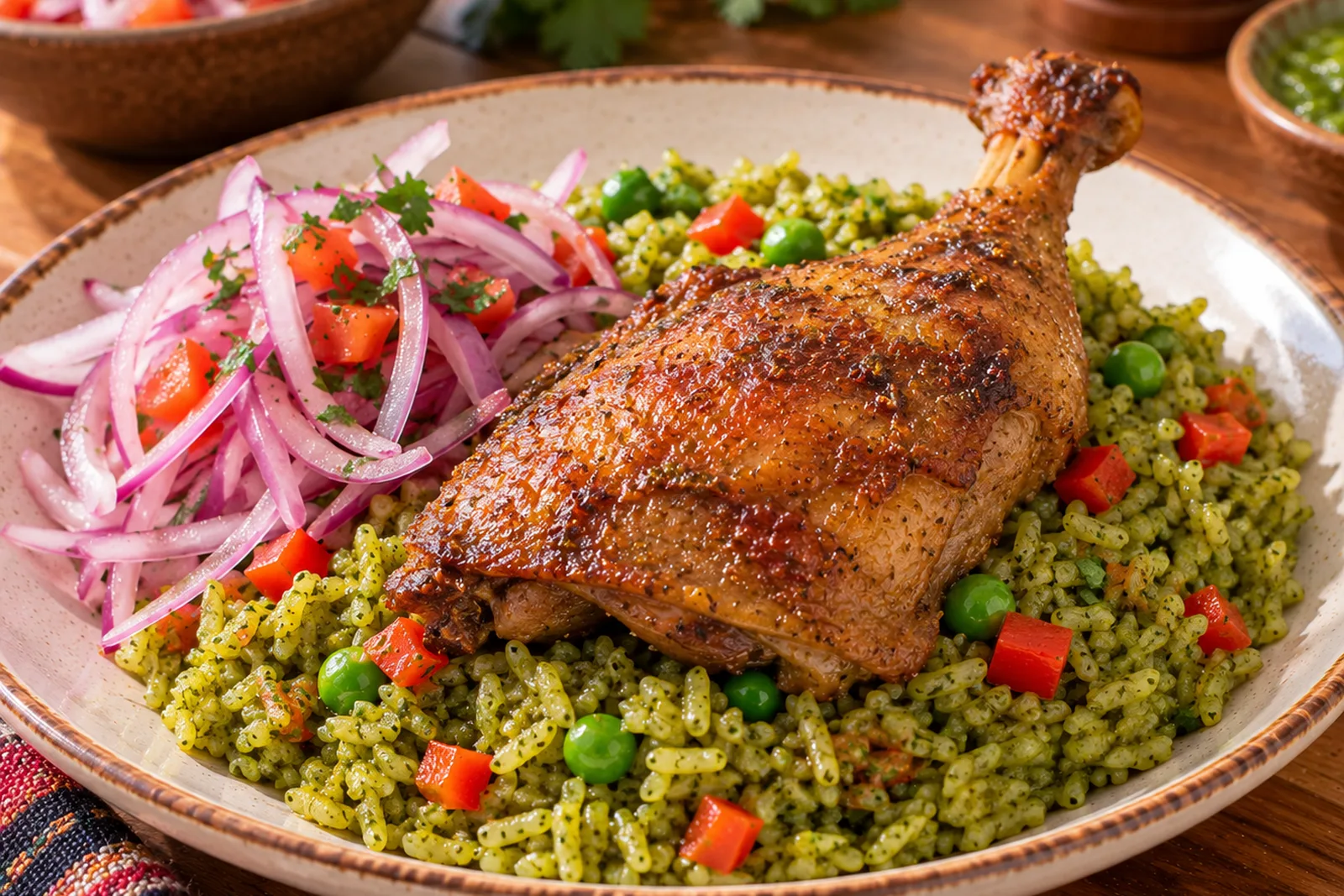

Arroz con pato (ah-ROHS kohn PAH-toh) is the signature dish of Chiclayo, a city on Peru’s northern coast: duck pieces marinated in garlic, vinegar and chile, braised until tender, then served on rice cooked in the braising liquid with a whole bunch of blended cilantro, which turns it a deep green. It’s a one-pot dish, and the rice is the star; the duck gives it fat and flavor. This version uses whole duck legs, which you can buy in a US Asian grocery or many large UK supermarkets, and dark beer, the usual stand-in for the traditional chicha de jora.
What arroz con pato tastes like, and the timing
How do you make Peruvian arroz con pato? Marinate 6 duck legs in garlic, vinegar, aji amarillo paste and cumin, brown them skin side down and cook red onion, garlic, chile and squash in the rendered fat. Braise the duck covered in 1 cup (240 ml) of dark beer and 3 cups (750 ml) of water for 60 to 75 minutes. Blend cilantro with the broth, measure 4½ cups (1.1 liters) of liquid and cook 3 cups of rice in it, covered, for 20 minutes with the duck on top. 180 minutes for 6 servings.
Expect fluffy, separate grains, dark green and herby, with a roasted malt note from the beer, peas, red pepper and carrot through it, and a duck leg on top that falls apart under a fork. It’s mild: aji amarillo, Peru’s orange chile, is more fruity than fiery. In Peru it comes with salsa criolla, a sharp red onion and lime relish that cuts the richness of the duck.
Timing. 30 minutes of prep and 2½ hours of cooking, but only about the first 35 minutes on the stove need you there: browning the duck and cooking the base. The braise and the rice look after themselves. Medium difficulty: nothing tricky, but the rice depends on measuring the liquid.
Shopping for arroz con pato
Duck legs, in the US and UK
Use whole legs, thigh and drumstick together, one per person. Legs stay juicy through an hour of braising; breast dries out. The recipe assumes legs of about 9 oz (250 g), typical of Pekin (Long Island) duck, the most common breed in the US. Muscovy and Moulard legs are bigger and firmer and may need up to 90 minutes.
- US. Asian supermarkets usually stock Pekin duck legs frozen and sometimes fresh. Some large supermarkets carry them at the meat counter, and duck farms ship them. A whole duck gives you only 2 legs, so you’d need 3 ducks for 6 people; freeze the breasts for another meal.
- UK. Many large supermarkets and online grocers sell fresh, skin-on duck legs in packs of two, about 1 lb (440 to 460 g), and butchers can order them. Don’t confuse them with tins or vacuum packs of confit duck legs, which are already cooked.
Frozen legs thaw in the fridge: allow about 24 hours for a 3¼ lb (1.5 kg) pack. Never on the counter.
Swaps and what they change
Chicken legs work with the same method, and the result is essentially Peruvian arroz con pollo. Use 6 whole bone-in, skin-on chicken legs, brown them for 8 minutes skin side down, and braise for only 25 to 30 minutes, until they reach 165°F (74°C) near the bone. Chicken renders less fat, so use 2 tbsp of oil for the base. The rice is just as green but less rich.
Confit duck legs let you skip the braise. Make the base with 2 tbsp of their fat, add the beer, water and blended cilantro, measure the liquid and cook the rice with the legs on top for the covered 20 minutes, so they heat through. It’s the fastest version, but confit is already salted: skip the marinade salt and taste before salting the rice. The rice tastes less of duck, since the liquid never braised anything.
Peruvian ingredients and supermarket stand-ins
| Ingredient | What it is | Where to find it | Easiest stand-in |
|---|---|---|---|
| Aji amarillo paste | Fruity, medium-hot orange chile, in a jar | Hispanic aisle of many US supermarkets; Latin grocers and online in the UK | 1 yellow bell pepper blended with ½ jalapeño: color and some heat, not the fruitiness |
| Loche squash | Small, very fragrant squash from northern Peru | Hard to find outside Peru | Butternut squash, the same species, milder; or leave it out |
| Chicha de jora | Slightly sour fermented corn drink | Peruvian shops, occasionally | Dark beer, same amount |
| Cilantro (coriander) | Called culantro in Peru | Any supermarket | None: it must be fresh |
Aji amarillo paste varies a lot in heat from brand to brand, so taste ½ tsp before you add it. Leftover paste makes Peruvian aji de gallina, creamy chicken with pecans.
Beer. Pick a dark lager or a mild brown ale, not a very bitter stout, which carries into the rice. For an alcohol-free version, use chicken stock with 1 tbsp vinegar.
Cilantro. Use one large bunch, 3½ oz (100 g), leaves and tender stems; cut off and discard the thick stems at the bottom, which make it bitter. Peruvians call it culantro, but the long, saw-edged leaf sold as culantro in Latin and Asian stores is a different, much stronger herb: buy regular cilantro. Dried cilantro gives neither color nor flavor. For an even deeper green, blend in 1 cup of baby spinach; you won’t taste it.
Equipment. A heavy 5- to 6-quart (5- to 6-liter) pot or Dutch oven with a tight lid, wide rather than tall, so the rice sits in a layer about 2 in (5 cm) deep and cooks evenly. A blender and a measuring jug.
How to make arroz con pato
Marinate
Pricking the skin, not the meat, helps the fat run out as it browns. The garlic, vinegar, chile and cumin marinade needs 30 minutes at least, the time it takes to chop the onion and wash the cilantro, but overnight in the fridge seasons the meat right to the bone.
Brown skin side down
Dry the skin first or it will spit and won’t crisp. Start over medium heat, not high: in 10 to 12 minutes the skin turns golden and gives up a lot of fat. That fat carries the flavor of the dish, but Pekin legs release far more than you need. Keep 2 tbsp in the pot and pour the rest into a jar in the fridge; it’s excellent for roasting potatoes.
The base
The onion takes 8 minutes to turn soft and translucent; scrape up the browned bits as it cooks. Then garlic for 1 minute, aji amarillo paste for 3 minutes, until the oil turns orange and shows at the edges, and the squash and carrot for 3 minutes.
When the duck is done
Covered, on low, at a gentle bubble, Pekin legs take 60 to 75 minutes. They’re ready when a fork slides in easily and the thigh meat comes away from the bone; by then they’re far past the 165°F (74°C) any poultry needs. If they’re still firm at 75 minutes, give them 15 more without raising the heat. Skim off the fat as it collects on top, or the rice will be greasy.
Cilantro last, and the right amount of liquid
This is the step that decides the color. Cilantro boiled with the duck for an hour turns olive and the rice comes out brownish, so it’s blended with 1 cup of the finished broth just before the rice goes in, and cooks only as long as the rice does.
Then measure everything in the pot, cilantro included. Rinsed long-grain rice needs 1½ cups of liquid per cup of rice: 4½ cups (1.1 liters) for the 3 cups here. How much broth is left after the braise changes each time, depending on how much your pot evaporated, which is why you can’t just tip the rice into whatever is there. The ratio scales: 2 cups of rice and 3 of liquid for 4 people, 4 and 6 for 8.
Fluffy green rice
Add the rinsed rice with the peas and pepper and boil uncovered for 6 to 8 minutes without stirring, until the liquid sinks to the level of the rice and small craters form. Lay the duck on top, cover tightly and cook 20 minutes on the lowest heat without peeking. Then rest 10 minutes off the heat; the steam finishes the grains. When you fluff it, every grain should be separate, tender and green, with no liquid left at the bottom.
Arroz con pato troubleshooting
- Gummy rice. Too much liquid, unrinsed rice, or stirring after it boiled. Measure 4½ cups and leave it alone.
- Hard in the middle. Too little liquid, or a lid that lets steam out. Sprinkle ¼ cup of hot water over it, put a clean towel under the lid and give it 10 minutes more on the lowest heat.
- Brownish rice. The cilantro cooked with the duck from the start. Blend it into the broth just before the rice next time.
- Greasy. The browning fat wasn’t poured off, or the braise wasn’t skimmed.
- Tough duck. It needs more time. Lift it out before the rice goes in and braise it separately, covered, in a little broth until it comes off the bone.
- Stuck bottom. The heat was too high during the covered 20 minutes. On the lowest heat, a thin toasted layer is normal; if it smells burnt, serve without scraping.
Heat, kids and allergens. With 3 tbsp of aji amarillo paste it’s mild, and most kids eat it happily; serve the salsa criolla on the side for them. Made with beer, it contains gluten (barley); chicha de jora is made from corn, but check the label. Braising reduces the alcohol without removing all of it, so use the stock version for children or anyone avoiding alcohol.
Making it ahead and feeding a crowd
The day before. Braised duck keeps beautifully overnight. Cook it through the braise, lift out the duck and refrigerate it and the broth separately, in shallow containers, within 2 hours. The next day, lift off the fat that has set on top of the broth, heat the broth, blend the cilantro with a cup of it, measure and cook the rice with the duck on top. That leaves about 45 minutes of work on the day.
For 12. Use two pots rather than one huge one: with 6 cups of rice in a single pot, the bottom catches before the top is cooked. Each pot gets 6 legs, half the base and its own measured liquid.
Serving. In Chiclayo it’s served in a wide bowl with the duck on the rice and salsa criolla alongside: 1 red onion, very thinly sliced, soaked 10 minutes in cold salted water, drained and dressed with the juice of 2 limes, a little sliced aji amarillo or chile, chopped cilantro and salt. The same relish goes with Peruvian arroz con mariscos, seafood rice with aji panca, which is served moister; arroz con pato should be fluffy and dry. If you like that cilantro braise, Peruvian seco de res, cilantro beef stew, uses the same cilantro and beer purée, but as a sauce.
Storing and reheating
Fridge. In a covered container within 2 hours of cooking, it keeps 3 to 4 days. Spread the rice in a shallow container rather than leaving it in the full pot, so it cools fast.
Freezer. 2 to 3 months, ideally the duck with a little broth in one container and the rice in another. Frozen rice comes back a little softer. Thaw overnight in the fridge.
Reheating. Rice in a covered skillet over medium-low heat with 2 or 3 tbsp of water, or covered in the microwave, stirring halfway. Duck covered with a splash of broth. Everything should reach 165°F (74°C) in the center. The green fades a little on reheating; a handful of chopped cilantro on top brings it back.
Duck is what makes this dish pricey. Chicken legs make the same pot much cheaper, and the rice and vegetables cost little. Leftover rice on its own can be stir-fried the next day like arroz chaufa, Chinese-Peruvian fried rice.
Arroz con pato FAQ
Why is the rice green? Blended cilantro in the cooking liquid. A large 3½ oz (100 g) bunch for 3 cups of rice gives a deep green; if yours is pale, it needed more cilantro or it cooked too long.
Can I use duck breast? Not in the braise; an hour in the pot dries it out. If breasts are all you have, cook the rice in chicken stock with the base, sear the breasts skin side down separately until they reach 165°F (74°C) in the center, rest 5 minutes, slice and lay them on the rice.
Can I use a rice cooker? For the rice, yes, not the braise. Put the rinsed rice, vegetables and 4½ cups of measured liquid in the cooker and lay the duck on top for the last 10 minutes to warm through.
Is it the same as Peruvian arroz con pollo? Same base, same cilantro rice. Duck gives a richer, fattier broth and needs an hour of braising; chicken needs half an hour.
Nutrition for arroz con pato
Per serving (one-sixth of the pot: one duck leg with rice and vegetables, without salsa criolla), worked out ingredient by ingredient from the quantities in the recipe:
- Calories: 725 kcal
- Protein: 39 g
- Carbohydrates: 90 g
- Fat: 21 g, of which 5 g saturated
- Fiber: 5 g
- Sugars: 6 g
- Sodium: 955 mg
The rice accounts for about 340 kcal per serving and the duck, without the fat poured off after browning, about 240. Jarred aji amarillo paste brings its own salt, so taste the liquid before adding the salt for the rice.
I braise the duck the day before almost every time, because the next morning the fat has set hard on top of the broth and lifts off in one piece, and the rice comes out cleaner for it. The cilantro I blend at the very last moment, never earlier: that’s what keeps the rice green. Josnaisis.