

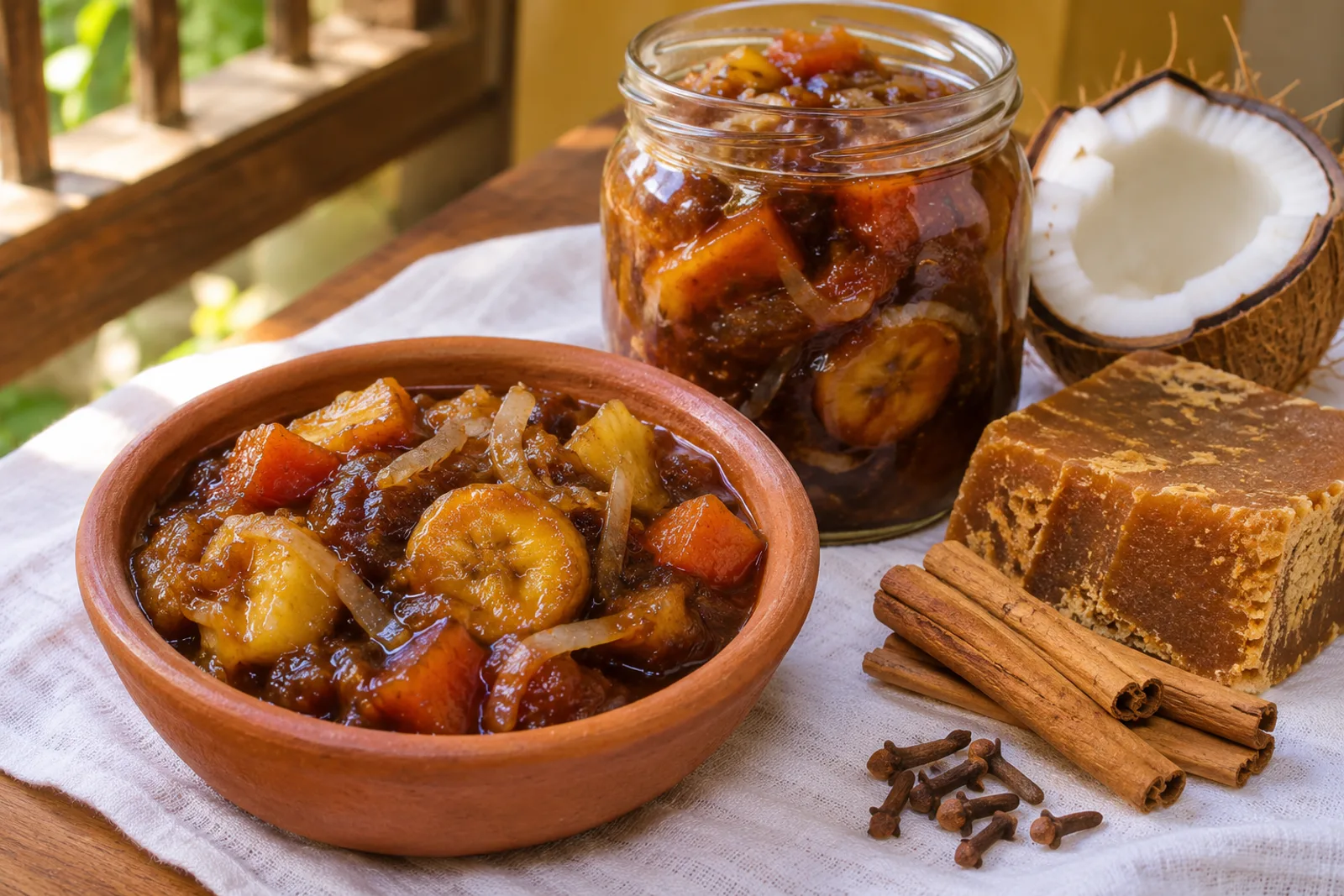

On Colombia’s Caribbean coast, mongo mongo is four fruits and coconut cooked together with panela, a raw cane sugar, until they collapse into one dark paste, and you don’t judge it with a thermometer but with a spoon: it is ready when stirring shows you the bottom of the pot. It is one of the Holy Week sweets of Colombia’s Caribbean coast, a fixture at the sweets festival held in Cartagena next to the Portal de los Dulces, and in the department of Sucre the same sweet goes by calandraca. This is a home batch of roughly 3 lb (1.5 kg) made with ripe plantain, green papaya, pineapple, mamey apple and coconut, with how to prep each fruit so the pot doesn’t turn bitter and what to buy in the US or UK when there is no mamey.
What mongo mongo is and what it tastes like
How do you make mongo mongo? Prep each fruit separately, 2.2 lb (1 kg) ripe plantain, 1.1 lb (500 g) grated green papaya, 9 oz (250 g) pineapple and 9 oz (250 g) mamey, and cook them for 30 minutes with the milk of half a coconut, cinnamon, clove and allspice. Add 1.1 lb (500 g) panela and keep stirring over low heat for about 60 minutes, until you can see the bottom of the pot. 135 minutes for 24 servings.
Think of a very thick fruit butter, darker than apple butter, that you can cut with a spoon. It tastes of molasses-like panela and ripe plantain, the pineapple adds acidity, the coconut a soft richness and the clove and allspice a warm, spiced finish. It is eaten cold, in small servings of about 2 oz (60 g), with a slice of salty white cheese, on cassava crackers (casabe) or on plain saltines.
Every family makes it a little differently. Some add guava or mango, some skip the coconut, and some cook it over a wood fire for a day or two, letting the fire die overnight. What all versions share is ripe plantain as the base, papaya, panela or sugar, and warm spices.
How it differs from other Latin fruit sweets
Mongo mongo is a blend of fruits that break down completely. In the other coastal sweets the fruit stays visible and the syrup has a precise set point.
- Venezuelan green papaya dessert. Strips of green papaya that stay whole and glossy in a raw cane sugar syrup taken off the heat at 223°F (106°C). One fruit, loose syrup; mongo mongo has four fruits plus coconut and no syrup at all.
- Colombian cocadas. Grated coconut cooked with sugar to 234°F (112°C) and dropped into little mounds that set firm. They share the bottom-of-the-pot test, but cocadas are shaped into pieces and mongo mongo goes in a jar.
- Colombian guava paste. Strained guava pulp that sets into a sliceable block at 226-230°F (108-110°C). It is firm; mongo mongo stays soft and fruity.
For the rest of the coastal Holy Week table, see the guide to Colombian Caribbean food and the Lent recipes.
Time. 135 minutes: 45 to peel, grate and prep the fruit, and 90 on the stove. Difficulty, medium. Nothing here is technically hard, but the last half hour needs you standing at the pot.
Ingredients, and what to use if you can’t find mamey
The recipe card makes a home batch of roughly 3.3 lb (1.5 kg); that is an estimate, since the final weight depends on how far you cook it down. Plantain is almost half the fruit and gives the paste its body; the panela weighs the same as the papaya.
Plantain, green papaya and pineapple
- Very ripe plantains. Look for skins that are mostly black. They are sweeter and mash easily; yellow, firm plantains give a paler, lumpier paste. These are cooking plantains, not dessert bananas, and a banana won’t hold up the same way.
- Green papaya. Unripe papaya with white or pale green flesh. It is grated and squeezed so it doesn’t flood the pot with water.
- Pineapple. Grated with its juice. It is what balances all that sugar.
Mamey apple is not mamey sapote
The mamey in mongo mongo is the mamey apple (Mammea americana), also sold as mammee apple or “mamey de Cartagena”: a round fruit with a thick brown skin, firm orange flesh, a sweet-tart flavor often compared to apricot and one or more large seeds. In Turbaco, near Cartagena, it is mostly sought out at Holy Week, precisely for making sweets.
Peel it and scrape away all the white membrane that clings to the flesh, plus any bits of seed coating. They are bitter and the bitterness spreads through the whole pot. When you simmer it, skim off the foam that rises, which is bitter too.
Don’t confuse it with the frozen “mamey” pulp in US Latin freezer aisles, which is usually mamey sapote: creamy, salmon-red flesh, a different fruit and a different flavor. Without mamey apple, use 9 oz (250 g) of mango that is just ripe but still firm, peeled and diced small: it goes into the pot raw with the other fruit, with no pre-cooking and no extra ½ cup of water. You lose the apricot-like tang and the sweet comes out a little sweeter and more perfumed, but it is still a homestyle mongo mongo; some coastal recipes already use mango.
Panela, piloncillo or sugar
Use the same weight of any of them, 1.1 lb (500 g). Panela, sold as piloncillo in Mexican shops, darkens the paste sooner and adds a molasses flavor. White sugar gives a lighter, caramel-colored paste that tastes more of the fruit; don’t wait for dark brown, go by the bottom-of-the-pot test. In the UK, dark muscovado sugar is the easiest supermarket swap and behaves like panela. If your panela is a hard block, grate it or chop it fine so it melts without lumps.
Coconut and spices
Half a mature brown coconut gives about 7 oz (200 g) of flesh. Grated and squeezed with 1 cup (240 ml) of warm water, it gives the milk for the pot. Without a fresh coconut, use 1 cup (240 ml) of canned coconut milk: it is thicker and richer, so the paste comes out a little more luscious. The spices are 1 cinnamon stick, 5 cloves and 5 allspice berries, crushed in a mortar.
Where to shop in the US and UK
- US. Plantains are in nearly every supermarket; let them ripen on the counter until the skins turn black. Green papaya is at Asian and Latin markets, since it is the base of Thai papaya salad. Panela or piloncillo is in the Hispanic aisle.
- UK. Plantains at large supermarkets and African-Caribbean grocers; green papaya at Thai and other Asian shops; panela online or in Latin American shops, or use dark muscovado.
Equipment. A heavy-bottomed pot of 5 quarts (5 liters) or more (a thin pot scorches before the paste thickens), a box grater, a food processor or potato masher, a long-handled wooden spoon and an oven mitt.
How to make mongo mongo, step by step
The work comes in two parts: knife and grater work, where each fruit is prepared on its own, and pot work, where everything cooks together first without the panela and then with it until it sets.
Prep each fruit separately
Peel, grate or mash each fruit into its own bowl, the way it is done on the coast. That lets you control each fruit’s water (the papaya gets squeezed, the pineapple keeps its juice). The mamey is the only one cooked ahead: 10 minutes in ½ cup (120 ml) of water, until soft.
First cook, 30 minutes without panela
All the fruit, the coconut milk and the spices go into the heavy pot over medium heat. In 30 minutes at a gentle boil the papaya softens, the plantain breaks down and the mixture turns into a coarse yellow purée. Stir every few minutes, scraping the bottom.
With the panela, until you see the bottom of the pot
The panela goes in once the fruit is soft. Added at the start, the mixture darkens and sticks before the papaya is cooked. Over low heat the paste takes about 60 minutes to set; a wider pot is faster and a bigger batch is slower, which is why the visual cue matters more than the clock.
To test it, drag the wooden spoon through the middle. If the trail stays open and you can see the bottom of the pot for 2 to 3 seconds before the paste closes back over it, it is ready. It firms up more as it cools, so don’t push it further.
What goes wrong with mongo mongo
- It tastes bitter. White membrane or seed coating was left on the mamey, or the foam wasn’t skimmed. There is no fix once it is mixed in; next time scrape until only orange flesh is left.
- It stuck and tastes burnt. Thin pot, high heat after the panela went in, or not stirring often enough in the last 30 minutes. If you feel it catching, move the paste to a clean pot without scraping the scorched bottom and carry on over low heat.
- It is runny. It came off the heat before the bottom of the pot showed, or the papaya wasn’t squeezed. Put it back over low heat and stir until you get the trail; a runny batch keeps for less time.
- Pale and bland. Underripe plantains. Black-skinned plantains and panela take it to dark brown; with white sugar a lighter color is normal, so don’t overcook it chasing a darker shade.
- Burns. Thick paste bubbles and spits like lava. Long spoon, a mitt on your stirring hand and kids away from the stove for the last half hour.
Allergens and who it’s for. No dairy, egg, gluten or tree nuts; it does contain coconut. It isn’t spicy. It is very sweet: 30 g of sugars per serving (1/24 of the batch), mostly from the panela.
Serving and storing mongo mongo
Serving. Cold or at room temperature, 2 to 3 tablespoons per person, with sliced salty white cheese (feta or queso blanco outside Colombia), cassava crackers or saltines. The salty cheese is what makes it so easy to eat.
Fridge. Divide it while still warm into small, shallow jars or containers so it cools fast, and refrigerate within 2 hours (1 hour if the kitchen is above 90°F / 32°C), at 40°F (4°C) or below. Eat it within 3 to 4 days, scooping with a clean, dry spoon; that is the cautious rule for any cooked food, since there is no tested shelf life for this sweet.
Freezer. To keep it longer than 4 days, freeze it in portions, in jars or tubs with ½ inch (1.5 cm) of headspace. It keeps its quality for 3 to 4 months. Thaw overnight in the fridge and eat within 3 to 4 days of thawing.
Not on the counter. This isn’t a sterilized preserve: it contains plantain and coconut, has far less sugar than guava paste and there is no tested canning method for it, so keep it refrigerated.
For gifts or a crowd. For Holy Week gift jars (tell people to refrigerate them and eat within 3 to 4 days), double the recipe: 4.4 lb (2 kg) plantain, 2.2 lb (1 kg) green papaya, 1.1 lb (500 g) pineapple, 1.1 lb (500 g) mamey, a whole coconut and 2.2 lb (1 kg) panela. You’ll need a 10-quart (10-liter) pot and the second cook will run longer.
Frequently asked questions
Are mongo mongo and calandraca the same thing? Yes. In Sucre the same fruit-and-panela sweet is called calandraca, and the fruit mix changes from house to house.
Why do some recipes take a day or two? Those are traditional versions cooked over wood in large pans, with much bigger quantities and very low heat, left overnight and finished the next day. This batch in a heavy pot usually reaches the set in around 90 minutes on the stove, though the pot and the plantains change the timing.
Can I make it without coconut? Yes. Replace the coconut milk with 1 cup (240 ml) of water. It comes out less rich, with a more direct fruit-and-panela flavor.
Can I add guava? Yes, it is one of the most common additions. Blend 3 or 4 ripe guavas with a little water, strain out the seeds and add the purée during the first cook.
Nutrition
Per serving, 1/24 of the batch (about 2 oz / 60 g if the batch comes out at the estimated weight), calculated from the amounts in the recipe card:
- Calories: 173 kcal
- Protein: 1 g
- Carbohydrates: 39 g
- Fat: 3 g, of which 2 g saturated
- Fiber: 2 g
- Sugars: 30 g
- Sodium: 13 mg
Almost half the calories come from the panela; the coconut milk brings the fat. A 1 oz (30 g) slice of white cheese adds about 90 kcal and a fair amount of salt.
What took me longest to understand about mongo mongo is that it has no exact minute: every pot, every stove and every plantain changes the timing, and the only reliable test is looking at the bottom. So I always make it in the heaviest pot I own and stay next to it with the spoon for the last half hour, with nothing else on the stove. Josnaisis.