
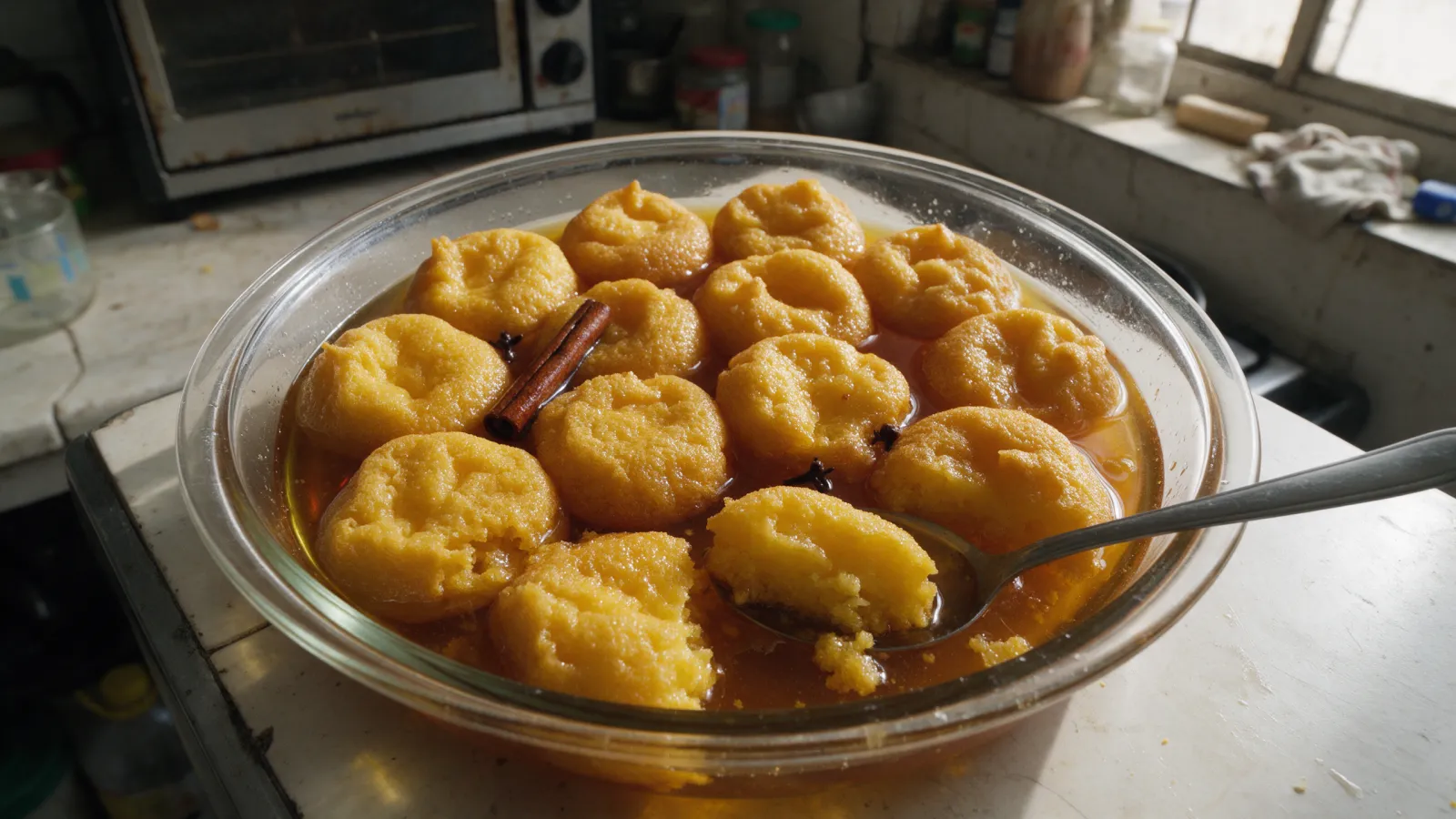

What do you do with 12 egg yolks? In Maracaibo, in western Venezuela, the answer is huevos chimbos (OO-eh-vohs CHEEM-bohs): yolks whipped with nothing but vanilla until they triple, set into small domes, and left overnight in a cinnamon and clove syrup with a splash of brandy. There is no flour, milk or baking powder holding them up, only air. That makes them unusually simple and unusually unforgiving, so this recipe spends its words on the two moments that decide everything: how long to whip and when they’re set.
What are huevos chimbos, and are they worth 12 yolks?
How do you make huevos chimbos? Whip 12 egg yolks with vanilla for 10 to 12 minutes to the ribbon stage, half-fill 12 buttered muffin cups and bake in a water bath at 320°F (160°C) for 30 minutes. Unmold, simmer 5 minutes in a syrup of sugar, water, cinnamon and cloves, add brandy off the heat and chill for 4 hours. Ready in 305 minutes for 6 servings.
They’re a syrup-soaked egg yolk dessert from the state of Zulia, in western Venezuela. They’ve closed the Maracaibo meal since the 19th century. Traditionally each one sets in a chimbera, a tiny lidded cup that makes a single round piece. A muffin tin is the practical stand-in.
Worth it if you have yolks to use up, like a very sweet dessert, and can make it a day ahead. Skip it if you want something light: a serving with all its syrup carries about 67 g of sugar. They also taste plainly of egg yolk, which some people love and others don’t.
Real time. 65 minutes at the stove, about 35 hands-on, plus at least 4 hours in the fridge. Difficulty, medium. Nothing is technical, but the whipping and the doneness test can’t be rushed.
Ingredients, with US and UK swaps
Everything is in a regular supermarket: 12 large eggs, 400 g (2 cups) sugar, 600 ml (2½ cups) water, 2 cinnamon sticks, 4 cloves, 2 tsp vanilla and 60 ml (¼ cup) brandy. Venezuelan and Colombian versions alike start from a dozen yolks. Where they part ways is the syrup, from a thick cup of sugar in half a cup of water to more than 2 pounds of sugar in three cups.
| Ingredient | What it does | If you don’t have it |
|---|---|---|
| 12 large yolks, 204 g (7.2 oz) | the whole structure | no swap; pasteurized liquid yolks are a different product and I haven’t tested them |
| Granulated sugar, 400 g (2 cups) | the syrup | UK caster sugar works the same; brown sugar makes it darker and molasses-tasting |
| Brandy, 60 ml (¼ cup) | aroma, Maracaibo-style | dark rum; sweet sherry, as in Mexican huevos reales; or nothing |
| Cinnamon sticks and cloves | spice the syrup | ground cinnamon clouds the syrup; use sticks |
| Chimbera | traditional mold | 12-cup muffin tin, silicone muffin cups, ramekins or small teacups |
What to do with the 12 leftover whites
You’ll have about 400 g (14 oz) of whites. Raw whites keep a year in the freezer and 2 to 4 days in the fridge. I freeze them in bags of 6, because a Colombian merengón takes exactly 6 whites, so one batch of chimbos feeds two merengones. The Swiss meringue on a Venezuelan bienmesabe uses 4 more.
Make-ahead plan and how to tell each stage is right
The syrup cooks while the yolks bake, so the stove time stays at 65 minutes. The fridge is the real cooking time for the flavor.
The day before is the right day. Made in the afternoon, they’re soaked through by lunch the next day. The one thing you can’t do ahead is the whipping: whipped yolks go straight into the molds.
Signs it’s going right.
- Whipped → after 10 to 12 minutes, tripled in volume, pale yellow, and a ribbon that holds 3 to 4 seconds.
- Set → after 30 minutes, doubled in height, springy to the touch, toothpick dry. Damp toothpick, 5 more minutes.
- Syrup → after 15 minutes of boiling, coats the spoon and drips in fat drops. It should not spin a thread.
- Soaked → next morning, a halved puff is wet from edge to center.
Whipping to the ribbon stage
Without flour, the only structure is yolk foam that sets around its air bubbles. Five minutes of whipping leaves too little air: the puffs bake dense and the syrup slides off. Keep going until the yolks triple and reach the ribbon stage, the same point you whip eggs to for a sponge cake; in a stand mixer that’s 10 to 12 minutes, about as long as the oven takes to reach 320°F. Peru Delights, whose Peruvian version uses 20 yolks, puts it at about a quarter of an hour.
Muffin tin, stovetop or sheet pan
The Zulia way is steam: cups standing in 2 inches of water in a lidded pot, set in 10 to 15 minutes. The oven version bakes them at 320°F (160°C) for 25 to 30 minutes in a water bath. The Peruvian sheet-pan version bakes at 350°F (175°C) for about 20 minutes and is cut into squares.
For a first batch I’d use the muffin tin. Stovetop heat varies from kitchen to kitchen, and the lid drips condensation onto the puffs. In the oven under foil, the timer means the same thing every time.
The syrup, and why it stays thin
400 g sugar in 600 ml water, boiled 15 minutes, gives a light syrup on purpose. Thick syrup coats the outside and takes ages to reach the center; thin syrup soaks in while the puffs are still warm and open. The 5-minute poach is gentle: at a rolling boil the puffs knock into each other and break. Add the brandy off the heat so it keeps its aroma.
Scaling for a crowd
| Guests | Yolks | Sugar | Water | Brandy | Format |
|---|---|---|---|---|---|
| 6 (2 each) | 12 | 400 g (2 cups) | 600 ml (2½ cups) | 60 ml (¼ cup) | 1 muffin tin, 30 min at 320°F (160°C) |
| 12 | 24 | 800 g (4 cups) | 1.2 L (5 cups) | 120 ml (½ cup) | 2 muffin tins |
| 15 | 24 | 800 g (4 cups) | 1.2 L (5 cups) | 120 ml (½ cup) | 8 x 12 in (20 x 30 cm) pan, 20-25 min at 350°F (175°C), 30 squares |
| 20 | 36 | 1.2 kg (6 cups) | 1.8 L (7½ cups) | 180 ml (¾ cup) | two 8 x 12 in pans of 18 yolks, 40 squares |
For the sheet-pan version I line the bottom with parchment, bake until the toothpick is dry, cut the squares in the pan and pour the boiling syrup over instead of poaching. The pan needs sides at least 2 inches (5 cm) high. A home mixer bowl handles a dozen yolks per batch comfortably; past two dozen, in my experience, they won’t whip properly.
Egg safety, alcohol, kids and allergens
Egg dishes should be cooked to 160°F (71°C). A puff that has doubled and tests dry is past that, and 5 minutes in boiling syrup at 212°F (100°C) leaves no doubt for something this small. The rule that matters afterwards is 2 hours: never leave them out of the fridge longer than that.
Alcohol. Spirits stirred into a boiling liquid and taken off the heat keep about 85 % of their alcohol. With 60 ml (¼ cup) of 80-proof brandy, that’s roughly 2.7 g of alcohol per serving, 1.3 g per puff, if you finish the syrup. For children or anyone not drinking, leave the brandy out; I add a 2-inch (5 cm) strip of orange peel to the syrup instead.
Kids. Without alcohol most children like them, though I serve them one, not two. Spice level, 0 out of 5. Allergens: egg, and dairy only from the butter used for greasing, which neutral oil replaces. There’s no flour or nuts; check your vanilla and brandy labels if you cook gluten-free.
Mistakes I’ve made or seen.
- They fall apart in the syrup → underdone inside, or the syrup was boiling hard.
- Rubbery, won’t absorb → under-whipped.
- Stuck to the tin → greased only the bottom, or unmolded hot. Butter the sides and wait 10 minutes.
- Taste like an omelet → too little syrup time. One night in the fridge fixes it.
- Syrup crystallized → stirred while boiling. Stir only before it boils.
Variations, and how chimbos differ from their relatives
- No oven → teacups in a covered pot with 2 inches (5 cm) of water, 12 to 15 minutes; a clean towel under the lid catches the drips.
- Less sweet → serve them drained and leave half the syrup behind, about 129 calories less per serving.
- Peruvian-style → sheet pan, raisins in the syrup and pisco instead of brandy, as in Peru Delights’ 20-yolk version.
- Zulia-style → brandy and vanilla in the syrup. Colombia has a similar sweet called huevos quimbos.
Spanish huevos moles from the Canary Islands cook 12 yolks with a thread-stage syrup in a double boiler and whisk them into a spoonable cream. Tocino de cielo from Jerez sets yolks and syrup over caramel in a water bath until it’s like flan. Mexican huevos reales from Puebla are the closest cousin: whipped yolks, but with baking powder, baked, then soaked in syrup with sherry and raisins. If you want an egg dessert made with milk instead, try the Venezuelan quesillo, Mexico’s cream cheese flan napolitano or the scorched-top jericalla from Guadalajara.
What huevos chimbos cost
At US city average prices for August 2026, a dozen grade A large eggs costs $2.27 and 400 g (0.88 lb) of sugar $0.90: $3.18 for the batch, about 53 cents a serving and 26 cents a puff. The eggs are about 72 % of that. Brandy, cinnamon, cloves and vanilla are left out; the brandy is the only thing that would really move the total, and you use just ¼ cup of the bottle. I don’t give a UK figure here.
Serving and storing
Serve them cold in a shallow bowl or a glass, 2 per person with a couple of spoonfuls of syrup. A cup of black coffee balances the sugar. On a Venezuelan dessert table they sit well next to dulce de lechosa, the green papaya in syrup.
Fridge: 3 to 4 days at 40°F (4°C) or below, covered and submerged. I eat them within 3 days; after that the syrup turns them too soft. Freezer: I don’t freeze them, because soaked yolk foam goes watery when it thaws. Reheating: don’t. If the syrup has thickened in the fridge, let them sit out 15 minutes before serving.
Frequently asked questions
How many egg yolks do huevos chimbos use? A dozen yolks makes 12 puffs, enough for 6. For 15 people, 24 yolks in an 8 x 12 in (20 x 30 cm) pan.
What is the ribbon stage? The whipped yolks have tripled, and a trail dropped from the whisk holds on the surface for a slow count of three or four. Expect a stand mixer to need 10 to 12 minutes and a hand mixer 3 more.
Why did my huevos chimbos fall apart? They weren’t fully set, or the syrup boiled too hard. Wait for a dry toothpick and keep the 5-minute simmer gentle.
Can I make them without alcohol? Yes. Leave the brandy out; nothing needs replacing. With 60 ml of brandy, about 2.7 g of alcohol stays in each serving.
Are the yolks safe to eat? Yes. Set until a toothpick is dry and then poached in boiling syrup, they go well past the safe 160°F (71°C).
How long do huevos chimbos keep? 3 to 4 days at 40°F (4°C) or colder, covered in syrup. They don’t freeze well.
Are huevos chimbos the same as huevos reales? Close relatives. Huevos reales from Puebla add baking powder and are usually baked in a pan and soaked in a syrup with sherry and raisins; chimbos are plain whipped yolks.
What else can I make with egg yolks? On this site, Colombian sabajón uses 6 yolks for 2 bottles of eggnog.
Nutrition
Per serving (two puffs with all their syrup), calculated from this recipe’s quantities, not counting the greasing butter:
- Calories: 393 kcal
- Protein: 5 g
- Carbohydrates: 68 g
- Fat: 9 g, 3 g of it saturated
- Fiber: 0 g
- Sugars: 67 g
- Sodium: 17 mg
Nearly all the sugar is in the syrup; leave half of it in the bowl and a serving drops to about 264 calories. The fat and protein come from the 34 g of yolk per serving, and the brandy adds about 22 calories.
The first batch of huevos chimbos I made myself, in Colombia, came out like little rubber balls because I stopped whipping when the yolks looked pale. Now the timer goes to 12 minutes and I don’t touch it until it rings. Josnaisis.