
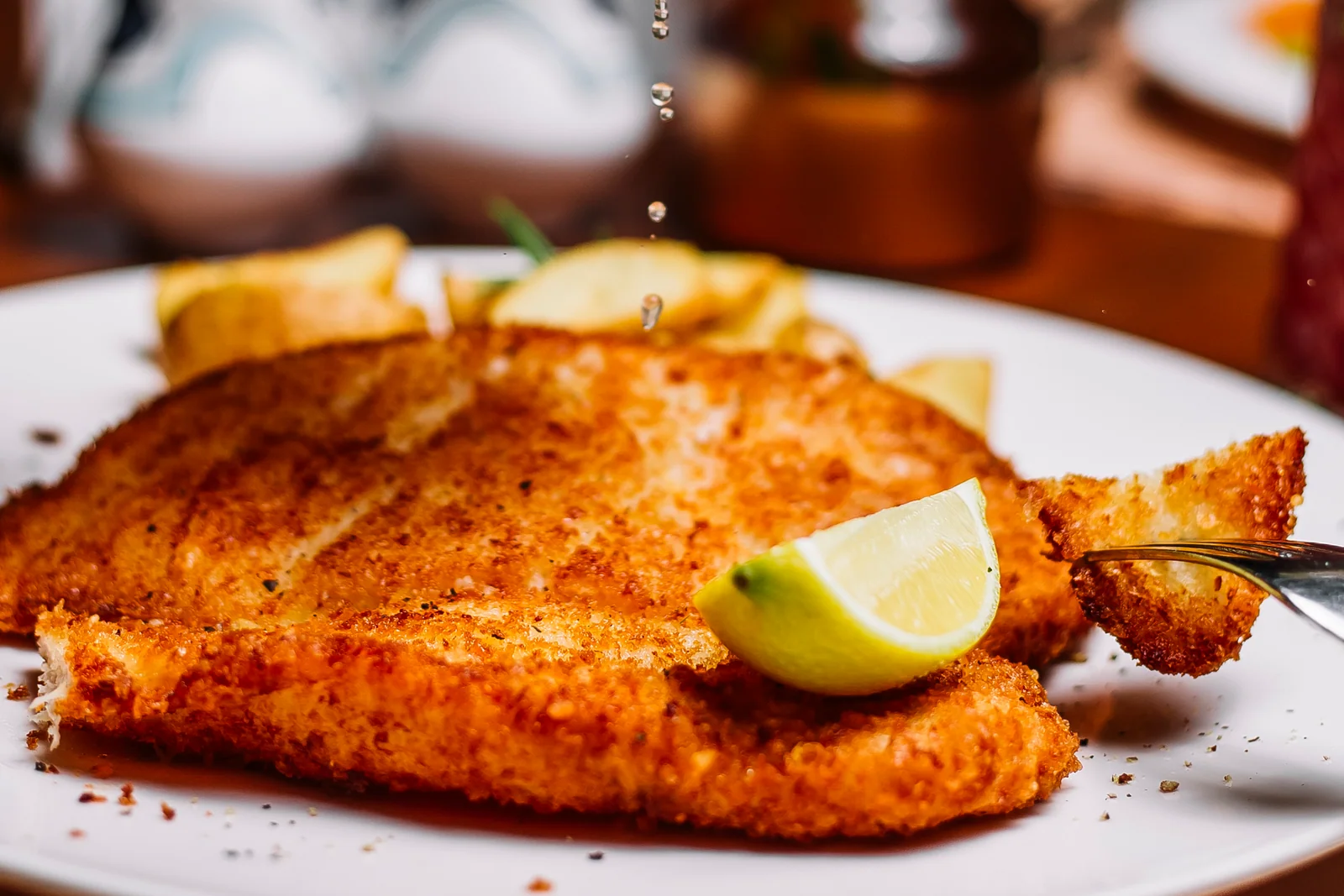

Pescado empanizado (peh-SKAH-doh em-pah-nee-SAH-doh) is the breaded fish fillet of Mexican home cooking: white fish dipped in flour, egg and fine breadcrumbs, shallow-fried until golden and eaten with rice, salad and a squeeze of lime. It turns up at Friday lunches during Lent, when many families skip meat, and in tacos the rest of the year. Unlike British fish and chips, there is no batter and no deep fryer, just a scant ¼ inch of oil in a skillet. This guide covers which fish to buy at a US or UK supermarket, what to do with frozen fillets, how to keep the coating on, how to tell the fish is cooked without drying it out, and how to reheat it so it stays crisp.
What is Mexican breaded fish?
How do you make Mexican breaded fish? Pat dry and season 1⅓ lb (600 g) of white fish fillets. Coat them in flour, beaten egg and breadcrumbs, pressing the crumbs on, and chill for 10 minutes. Shallow-fry in 1¼ cups (300 ml) of oil at 350-355°F (175-180°C) for 3 to 4 minutes per side, until the center reads 145°F (63°C), and drain on a rack. Ready in 45 minutes for 4 servings.
It is close to what you might know as pan-fried breaded fish or a homemade fish fillet, and the method is the same three-dish breading used for Mexican beef milanesa. Two things make the Mexican version its own: crushed saltine crackers are a common alternative to breadcrumbs, and it is served with lime and salsa rather than tartar sauce and vinegar. If you want a puffy beer-battered fish instead, that is a different technique, the one in Baja-style fish tacos.
Which fish to buy in the US and the UK
Any lean, mild white fish, boneless and skinless, about 1 to 1.5 cm (½ in) thick. Thinner fillets dry out before the crumbs brown; thicker ones need lower heat and more time.
| Fish | Where to find it | How it fries |
|---|---|---|
| Tilapia | US supermarkets, often frozen | thin and mild, the easiest to find in the US |
| Cod | US and UK, fresh and frozen | large, juicy flakes; fillets are often thicker |
| Haddock | mainly UK | firm and sweet, the classic UK chip-shop fish |
| Pollock | US and UK, often the cheapest frozen fillet | firm and mild, good value |
| Hake | UK and Spain | tender, fine flakes, handle gently |
| Swai or basa | US, frozen | very soft, breaks if moved too much |
| Red snapper | US fish counters | firm, more flavor, more expensive |
Frozen fillets work fine. Most home cooks use them. Thaw them overnight in the fridge on a plate, or, if you are short on time, seal them in a zip-top bag and submerge it in cold water, changing the water every 30 minutes. Never thaw on the counter or in warm water. Then pat them dry twice, pressing with paper towels: frozen fish releases a lot of water, and that water is what lifts the coating off in the pan.
Ingredients, coatings and equipment
The recipe card has the exact amounts. Allow 150 g (5 oz) of raw fish per person.
Choosing the coating.
- Fine dried breadcrumbs → the classic. A smooth, even, golden crust. Plain, unseasoned ones work best; Italian-seasoned crumbs add herbs that are not part of the dish.
- Crushed saltines → whizzed in a blender or crushed in a bag with a rolling pin until fine. Crunchier and saltier, and it browns a little faster, so cut the salt on the fish to ½ tsp and watch the second side. In the UK, where saltines are hard to find, stick to breadcrumbs or panko.
- Panko → a thicker, jagged coating and the crunchiest of the three. Not traditional, but very good.
Why milk or water in the egg. The 2 tablespoons thin the egg so it coats in a fine layer and drips off cleanly. Thick egg leaves a rubbery layer that separates from the fish.
Equipment. A heavy or nonstick 28 to 30 cm (11 to 12 in) skillet, a wide fish spatula for turning (tongs break the fillets), a slotted spoon, three shallow dishes and a wire rack set over a sheet pan. An instant-read thermometer takes the guesswork out of both the oil and the fish, but you can manage without one.
Allergens. Fish, wheat (flour and crumbs), egg and, if you use it, milk.
Make-ahead plan for a weeknight or a Lent Friday
| When | What to do |
|---|---|
| The night before | Move frozen fillets to the fridge to thaw on a plate. |
| Up to a few hours ahead | Dry, season and bread the fish; keep it in one layer on a tray, covered, in the fridge. |
| 15 minutes before eating | Heat the oil, about 5 to 8 minutes. |
| At the table | Fry in two batches of 2 fillets, about 8 minutes each including the turn and the oil recovering. |
Breaded raw fillets also freeze well, so it is worth breading a double batch. More on that below.
How to fry it and tell when the fish is done
Oil at 350-355°F (175-180°C). With 1¼ cups (300 ml) in an 11 to 12 inch (28 to 30 cm) skillet, the oil sits about a scant ¼ inch (5 mm) deep, roughly halfway up a thin fillet. That is enough, since you turn each fillet once.
- No thermometer? A pinch of breadcrumbs should sizzle on contact and turn golden. If it sinks and barely bubbles, the oil is too cool; if it darkens within seconds, it is too hot.
- Two fillets per batch. Each one cools the oil. Crowd four into the pan and the crumbs soak up fat instead of sealing.
- Hands off for the first minute. The crust needs to set before it will release from the pan.
- Turn once, away from you, sliding the spatula under the whole fillet to avoid splashes.
Timing by thickness. About 3 to 4 minutes per side for ½ in (1.5 cm) fillets, 2 to 3 minutes for thin tilapia under 1 cm (⅜ in), and up to 5 minutes per side for thick ¾ in (2 cm) cod, with the heat turned down a notch so the crust does not scorch before the center cooks.
Done, not dry.
- With a thermometer: 145°F (63°C) in the thickest part. Take it out as soon as it gets there.
- Without one: push a fork into the thickest part and twist gently. The flesh should be opaque white and flake apart. If the center still looks glassy and translucent, give it another minute.
- Overdone: the fish shreds into dry strands. Keeping all the fillets a similar thickness is the best protection, because the thin one overcooks while the thick one catches up.
Drain on a rack, not paper. On paper towels the underside steams itself soft within a couple of minutes. If paper is all you have, serve within a minute. Never cover fried fish to keep it warm.
Troubleshooting greasy, patchy or broken fillets
- Greasy and pale → oil below 350°F (175°C) or too many fillets at once. Wait for the temperature and fry two at a time.
- Dark outside, raw inside → oil too hot or a fillet thicker than ¾ in (2 cm). Turn the heat to medium, or slice thick fillets in half horizontally.
- Coating slides off → wet fish (especially after thawing), too much flour, egg that did not drip off, crumbs not pressed on, or turning more than once.
- Fillet breaks when turned → tongs instead of a spatula, a very soft fish like swai, or turning before the first side was golden. Cut swai into pieces about 4 in (10 cm) long.
- Burnt taste → crumbs from the last batch left in the oil. Skim between batches.
- Too salty → saltines plus the full teaspoon of salt. Halve the salt when using crackers.
Baked or air fryer breaded fish
Bread the fish exactly as for frying, then brush or spray both sides with oil, about 2 teaspoons for all four fillets. Without it the crumbs stay pale and dusty.
- Oven: heat to 425°F (220°C). Set the fillets on a wire rack over a sheet pan so hot air reaches the underside, and bake 12 to 15 minutes without turning, until golden and 145°F (63°C) in the center. Straight on the pan, the bottom goes soft.
- Air fryer: 400°F (200°C), in one layer with space between them, 8 to 12 minutes depending on thickness. Turn them halfway only if they are firm, like cod or pollock; thin tilapia and swai tend to break, so leave them be.
Both give a lighter, slightly drier crust than frying, still crisp, with a fraction of the oil, and bring each serving down to about 280 calories.
Feeding 8 or more. Double the recipe and run two skillets at once. Keep finished fillets on a rack in a 200°F (95°C) oven, uncovered, for no more than about 15 minutes before the crust starts to soften.
What drives the cost. Almost all of it is the fish. Frozen tilapia, pollock and swai are the budget choices; snapper and fresh cod cost far more, and under a crust the difference shows less than it would on a plain grilled fillet.
What to serve with Mexican breaded fish
At a Mexican table it comes with Mexican red rice, a simple lettuce, tomato and onion salad, and lime wedges. Other good matches:
- A cold macaroni salad → creamy Mexican macaroni salad is a family-lunch classic; leave out the ham during Lent.
- Potatoes → fries, mashed or boiled with a little butter.
- As tacos → cut each fillet into 3 strips and tuck them into homemade corn tortillas with shredded cabbage, fresh pico de gallo and a tangy tomatillo salsa verde. Four fillets make about 12 tacos.
- A cold sauce → mayonnaise with lime juice, or with a little chopped chipotle in adobo. Serve it on the side or spoon it on at the last moment; fish left sitting in sauce goes soggy.
Storing and reheating so it stays crisp
- Breaded raw, in the fridge: a few hours on a tray in one layer, covered, and always within 2 days of buying fresh fish.
- Breaded raw, in the freezer: freeze on a tray for 2 hours without the pieces touching, then bag them with parchment between layers. I use them within 3 months. Thaw overnight in the fridge on a rack and fry as usual.
- Cooked, in the fridge: cool uncovered on the rack, refrigerate within 2 hours in a container lined with paper towel, and eat within 3 to 4 days.
- Cooked, in the freezer: 4 to 6 months, but the crust loses most of its crunch once thawed. Freezing raw is the better plan.
Reheating. Air fryer at 350°F (180°C) for 4 to 5 minutes, or the oven at 400°F (200°C) for 8 to 10 minutes on a rack, until piping hot, 165°F (74°C) inside. Both bring back the crunch. A skillet with a teaspoon of oil, 2 minutes per side over medium heat, also works. The microwave heats it but leaves the crust soft, so save it for fish you plan to flake into tacos.
FAQ
Can I bread fish without eggs? Yes. Spread a thin layer of mayonnaise on the fillets, about 4 tablespoons in total, or use a paste of 4 tablespoons of flour and 6 of cold water. The crumbs stick just as well, though the coating is a little thinner.
Should I marinate the fish in lime first? It is not needed. If you like the flavor, sprinkle it with the juice of half a lime for no more than 10 minutes, since the acid starts to firm the surface, then dry it very well or the coating will slip. I prefer to put the lime on the table.
Can I fry homemade breaded fish straight from frozen? Not in a skillet. The ice cools the oil, the coating soaks up fat, and the crust darkens before the center reaches 145°F (63°C). Thaw it in the fridge overnight.
How many calories are in Mexican breaded fish? About 330 calories per 5 oz (150 g) tilapia fillet, without sides: 35 g protein, 18 g carbohydrate, 13 g fat (2 g saturated), 1 g fiber, 1 g sugar and 830 mg sodium. I worked it out from the fish plus the flour, egg and crumbs that actually stick, and about 8 g of oil absorbed per fillet, which is my estimate for a thin fillet shallow-fried and drained on a rack.
My rule for this dish is to bread more than I need. Whatever is left over goes into the freezer raw, separated with parchment, and on an evening when nobody planned dinner it moves to the fridge in the morning and becomes fish tacos at night with cabbage, lime and whatever salsa is open. It has rescued more weeknights than any other recipe I make with frozen fish. Josnaisis.